For decades climate change was a topic for predominantly environmentalists. Since the early 2010s, this has changed dramatically. The transformation culminated in the Paris Climate Agreement of 2015 where the world agreed on a comprehensive path to tackle an existential threat. Consequentially the energy transition has strongly gained in importance as countries around the world are racing to replace their carbon-intensive economies with green alternatives.
The massive installment of wind turbines and solar PVs is the first step. As the energy transition progresses, countries across the globe are confronted with challenges of an energy mix dominated by renewables. The intermittent nature of wind and solar electricity production affects the reliability of the power grid. A solution could be the storage of energy into hydrogen through the process of electrolysis.
Furthermore, the rapid development of electric vehicles has exposed the limitations of battery-based transportation technologies. The significant decrease in the battery production costs has, for the first time in history, made it affordable for the wider public to switch to EVs. Environmental considerations have even pushed the EU towards regulations obliging the car industry to develop more sustainable products. However, the technological limitations of EVs require an alternative.
While battery-vehicles have become the way forward for smaller vehicles, the technology doesn't seem fit for heavy duties and long-range transportation. The characteristics of fuel cell-based vehicles make hydrogen, potentially, a suitable alternative.
The lowering of costs remains the biggest challenge, as was the case with renewables. To make hydrogen a plausible choice to complete the energy transition, the production costs of fuel cells need to be decreased significantly. Already the price of electrolysis-produced hydrogen has decreased by 60 percent in the past 10 years from $10-$15 to approximately $4-$6/kg. While it is a significant development, more needs to be done.
The decreasing costs are not a coincidence as governments and companies are responding towards an urgent challenge and changing attitudes towards hydrogen. The massive global attention for the energy-carrier has even spurred some to indicate a potential ‘hydrogen hype’. The coining of this term shows that the future isn’t fixed yet.
However, that hasn’t stopped a bull market on shares of hydrogen cell-producing companies. According to Adam Collins, an analyst at Liberum, "after years of false dawns, investors are realizing clean hydrogen and fuel cells have an important part to play in the energy transition, particularly heavy-duty mobility and heavy industry."
ITM Power’s share value, for example, are up by more than 45 percent this year, which is their highest since 2007. Swedish Powercell’s value has risen 28 percent in the same period and over 342 percent in the past year. This shows the enormous expectations of investors. And to some extent, there is a solid base for these forecasts to become reality.
There are several reasons why the current cycle is much more promising than in the past where a looming hydrogen economy did not materialize. First, there is a consensus in much of the world that climate change is an existential threat right on our doorstep. This asks for rigorous efforts to limit the most damaging effects of global warming.
Second, the massive installment of wind turbines and solar PVs is creating an abundance of electricity, which at certain moments threatens the stability of the power grid. Hydrogen is touted as a solution for energy storage and the flexibility of the grid to solve the problem of intermittency. Also, the availability of cheap electricity improves the business case for green hydrogen.
Furthermore, it is encouraging that the technology for the creation of a hydrogen economy already exists. The production of fuel cells, for example, is largely done by hand due to the current size of the market which is relatively small. This doesn’t justify the massive investments necessary for automatization and mass production. Therefore, it seems a matter of time before the combination of regulations and market developments create the right environment for the development of a hydrogen-based economy.
primary energy sources
Improved Filtration and Reliability
A frequent challenge is that equipment is not always able to satisfy the industry’s demand for efficient, economical, safe, and energy-conserving gas solid separation processes. Our ceramic and metallic elements provide high temperature gas filtration capabilities and last longer than competitive products. The systems are installed at coal gasification and methanol to olefins plants. The liquid/liquid coalescers are used to remove oil from process water.
Our Coal to Gas Filter Elements Effectively Filter Solids at Hot Elevated Temperatures
Our solution provides a long-life particulate separation of high temperature, chemically aggressive gases for integrated gasification combined cycle (IGCC) / pressurized fluidized bed combustion (PFBC) plants.

Premium Gas Solid Separation (GSS) system is a sintered porous metal or ceramic filter element. Our inorganic filter medium is designed for surface filtration. It can withstand temperatures from 232 ̊C (450 ̊F) to 1000 ̊C (1832 ̊F) and pressures in excess of 1000 psid (69 bard) without altering filtration characteristics.
Our coal to gas filtration solutions improve performance and reduce maintenance under the extreme environment of coal gasification and incineration.
We offer a broad spectrum of products and solutions for the Chemical industry. Scroll down to view our recommended products for your applications.
The production of hydrogen from gas and coal may be necessary to fill a potential gap in the global supply energy in the future, and Australia may be ideally placed to emerge as a major player in the global hydrogen market, Australia’s chief scientist, Dr Alan Finkel has told the clean energy sector at a conference in Sydney.
Speaking at the 2019 Australian Clean Energy Summit, Finkel said that wind and solar have emerged as the most viable new sources of zero-emissions energy going into the future, as the sources have overcome the cost, scale and social challenges faced by other energy sources, including nuclear, biofuels and wave or tidal energy.
Finkel was confident that Australia was well-positioned to become a major global supplier of clean hydrogen, with the abundance of sun, wind resources and land necessary to produce sufficient levels of clean energy that Australia could be in a position to export clean energy overseas.

While Finkel remains confident that clean energy resources will be sufficient to meet the world’s future energy needs, there is still a long way to go before renewables become the dominant source of primary energy.
Fossil fuel supplies still represent around 81% of the global primary energy supply, with renewables from sources like wind and solar needing to grow by 70-times their current levels before they will match current contribution of sources like coal, gas and oil.
However, Finkel recognised a gap in the current supply of clean energy, the ongoing need for a storable transport fuel and suggested that hydrogen would be the best placed to meet that need.
While hydrogen is able to be produced directly via renewable energy sources, using electricity generated by wind and solar projects to convert water to hydrogen via electrolysis, Finkel questioned whether it would be possible to produce hydrogen with the scale and diversity of supply needed to meet the needs of a global energy market.
In raising the question of whether the production of hydrogen from coal or gas would be necessary, Finkel raised concerns about the prospect that the global energy market may become reliant on two sources of primary energy, being wind and solar.
Finkel suggested that the use of coal and gas for the production of hydrogen, when paired with the total, or near total capture of emissions from the production process, could serve as a third primary energy source in the future.
“There are two things that concern me, one is scale, and the other is diversity,” Finkel said.
“It scares me to think in the future we may only have to primary energy sources,”
“Now, the sun will always be shining, and the wind will always be blowing. But who knows what the challenges may be for land access rights, transmission rights, climate change impacting weather patterns, or one of those spectacular volcanos like Krakatoa, that could lead to a month of shade.
“Is there a third? Could we increase our diversity? Well hydrogen from coal and natural gas could be something that has to be given consideration, as it is not reliant on solar and wind as an input, its using fossil fuels repurposed to produce a clean fuel.”
“Of course, it will need carbon capture and storage to work”.
As the chief scientist, Finkel previously completed a review of the national energy market, which recommended the implementation of a Clean Energy Target to support investment in new electricity generation capacity in Australia, while reducing emissions. A recommendation that was ultimately rejected by the Turnbull Government.
Finkel is currently leading the development of the National Hydrogen Strategy, which is expected to the delivered by the end of the year.

gasify solid fossil fuels
Power plants that combust or gasify solid fossil fuels generate large quantities of solid residues, principally ash, slag and desulfurization/sulfur byproducts. More specifically, coal-consuming electric utilities now produce over 100 million tons of coal utilization byproducts (CUBs) annually in the United States. Since 1966, the American Coal Ash Association (ACAA) has prepared annual surveys of CUB production and consumption by its members, which consist primarily of coal-burning electric utilities. These surveys concern the highest-volume CUBs: fly ash, bottom ash, boiler slag, and flue gas desulfurization (FGD) by-products. The data are instructive in indicating trends in production and usage of these by-products in major applications. Table 1 shows the production and use figures for 2012, the most recent year available.
The ACAA data show that fly ash from conventional coal combustion is the single largest material by category to be produced. While a portion of this (44.5%) is gainfully utilized in applications such as concrete aggregate, structural fill, etc., the remaining 55.5% is disposed of in ponds and landfills. Because constituents can subsequently leach from disposed wastes, there is potential for components to migrate to surface and ground waters. Groundwater contamination can occur when rainwater percolates through waste, separates (or leaches) hazardous constituents from wastes, and carries the hazardous constituents into the groundwater supply. Also, accidental releases from coal ash ponds have occurred with regrettable environmental consequences, exemplified by the TVA Kingston coal ash slurry spill in 2008 and Duke Energy’s Eden, North Carolina (Dan River) ash release in 2014.
A review of 46 power plant disposal sites from 12 states in the USA and abroad demonstrated that a number of different waste disposal sites had one to several constituents exceed the U.S. Environmental Protection Agency's (EPA) MCL, SMCL or WQC1 limits by an order of magnitude or more in down-gradient wells, ash pond effluents, aquatic receiving systems, etc.2 Given this type of concern, EPA had initially decided that federal regulations were needed due to some evidence of contamination from power plant wastes, the significant inconsistencies in disposal standards between states, and different disposal methods being used (storage in landfills vs. strip mines), and strong public support for such standards. However, in the Spring of 2000, EPA reached its final decision on whether federal regulations should be established to set the minimum safeguards required at all power plant waste disposal sites, issuing a Final Regulatory Determination that regulation of ash as a hazardous waste was not warranted, and determined that voluntary Resource Conservation and Recovery Act (RCRA) Subtitle D (nonhazardous) national standards would need to be developed for CUBs disposed in landfills or surface impoundments and used in filling surface or underground mines. They also determined that no additional regulations were warranted for CUBs that are used beneficially (other than for minefilling). In the regulatory determination, EPA supported increases in beneficial uses of CUBs, such as additives to cement and concrete, waste stabilization, and use in construction products.
The result of EPA’s determination was a marked trend observed in the following years, in which CUBs use volume increased from 32.1 million tons in 2000 to a peak of 60.6 million tons in 2008. However, in 2008 the TVA Kingston coal ash slurry spill occurred, which prompted EPA to commence rulemaking which caused regulatory uncertainty over coal ash utilization (prompting decreases in CUBs use of 51.9 million tons in 2012, down from 56.6 million tons in 2011 and well below the 2008 peak3). However, in a recent Consent Decree signed by all of the parties to a federal lawsuit that sought to compel a deadline for EPA, the Agency agreed to a December 19, 2014, deadline and continued to signal that its final regulation would be promulgated under the “non-hazardous” Subtitle D of RCRA pertaining to coal combustion residuals. In July 2016, EPA signed a direct final rule on disposal of coal combustion residuals, which because effective October 2016.4 Beneficial use of residuals is an important aspect of the recently finalized CCR Disposal Rule,5 which has demonstrated that regulatory trends and the need to better protect the environment, as well as public sentiment, clearly favor power generation technologies that can demonstrate safe disposal or beneficial use of solid by-products.
integrated gasification combined cycle
The Wabash River Coal Gasification Repowering Project is one of two demonstrations of advanced integrated gasification combined cycle (IGCC) technology in the United States. It was selected by the U.S. Department of Energy (DOE) in September of 1991 as a Round IV Demonstration Project for the Clean Coal Technology (CCT) Program. The IGCC plant is a repowering facility in the sense that it was built to replace a dated conventional pulverized coal power plant. Construction began in July of 1993 near West Terre Haute, Indiana, followed by operational startup in November of 1995. The project demonstration phase was completed and turned over for commercial operation in December 1999. In 2005, the plant was re-started under new management. SG Solutions LLC (SGS) owns and operates the Syngas Plant, whereas Wabash Valley Power owns the power generation portion of the plant, which is operated by Duke Energy.
Project Participants
The Wabash River Coal Gasification Project Joint Venture was formed in 1990 by Destec Energy, Inc. of Houston, Texas and PSI Energy. PSI Energy was an investor-owned utility whose service covered 62 of the 69 counties in Indiana. Along with Cincinnati Gas & Electric Company, PSI was owned by Cinergy Corporation, formed in 1994 and acquired by Duke Energy in 2006. Destec was purchased by Houston-based NGC Corporation, in 1997, and changed its name to Dynegy, Inc. the following year. In December of 1999, Global Energy Inc. purchased Dynegy’s gasification assets and technology. This included Dynegy’s synthesis gas (syngas) facility at the Wabash River Coal Gasification Repowering Project, as well as the right, title and interest in Dynegy’s proprietary gasification technology and related patents. Dynegy’s gasification projects in development at the time were also part of the acquisition. In 2005, the facility was handed over to SGS, who currently owns and operates the plant.
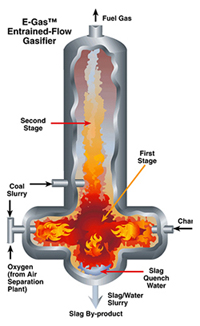
The gasification technology, developed originally by Dow Chemical, was first applied to power applications at its Plaquemine, Louisiana, chemical complex. Following implementation at this facility, the technology was transferred to Destec, a partially held subsidiary of Dow Chemical. The technology was later acquired by ConocoPhillips. CB&I currently licenses this process technology under the name E-GAS™.
The gasification technology, developed originally by Dow Chemical, was first applied to power applications at its Plaquemine, Louisiana, chemical complex. Following implementation at this facility, the technology was transferred to Destec, a partially held subsidiary of Dow Chemical. The technology was later acquired by ConocoPhillips. CB&I currently licenses this process technology under the name E-GAS™.
Site Description
The demonstration site is located in a predominantly rural area on the Wabash River outside of West Terre Haute, Indiana. PSI’s Wabash River Station was originally a mine mouth plant, and most of the new facility is built over land which was previously shaft-mined in the early 20th century. The site is bounded by the Wabash River to the east, woodlands and agricultural areas, a reclaimed strip mine, and residential areas 0.2 miles to the southeast and 1.5 miles to the north. Downtown Terre Haute is about eight miles south and there are no nearby wilderness areas or national or state parks. The coal gasification repowering facility is located immediately northwest of PSI’s Wabash Generating Station on land which was donated by the Peabody Coal Company. This 15 -acre plot contains the gasification island, air separation unit, water treatment facility, and the gas turbine and heat recovery steam generator (HRSG) tandem are located adjacent to the existing station. A previously used ash pond was converted for wastewater and storm water use.
The Wabash River IGCC Power Plant is designed to use a variety of local coals with maximums of 5.9% sulfur content (dry basis) and a higher heating value of 13,500 Btu/lb (moisture and ash free). A high-sulfur Midwestern bituminous coal from the No. 6 seam at Peabody’s Hawthorn Mine in Indiana was selected for initial operation. In addition, petroleum coke and blends of coal and coke were tested at the facility.
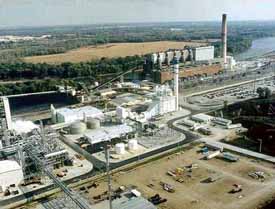
Wabash River IGCC Power Plant
Plant Description
The design for the gasifier used in this project was based on Destec's Louisiana Gasification Technology, Inc. (LGTI) gasifier, which was of similar size and operating characteristics. The LGTI gasifier was operated for more than 34,000 hours from April 1987 through November 1995. Experience gained in that project was considered in the design of the Wabash River facility and eliminated much of the risk associated with scale-up and process variables.
Coal is first slurried with water and fed with 95%-pure oxygen to the first stage of the gasifier. The coal is partially combusted in this stage to maintain a temperature of approximately 2,500 °F (1,371 °C). The majority of the coal reacts at this temperature with steam to produce the raw syngas. Ash in the coal melts and flows out of the bottom of the gasifier vessel as slag. Additional coal slurry is added to the second gasification stage where it undergoes devolatilization, pyrolysis, and partial gasification to cool the raw syngas and enhance its heating value. The raw syngas is then further cooled to produce steam for power generation. The steam is generated at a pressure of about 1,600 psia.
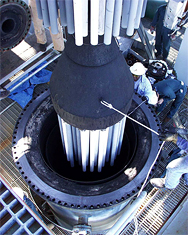
Candle Filters
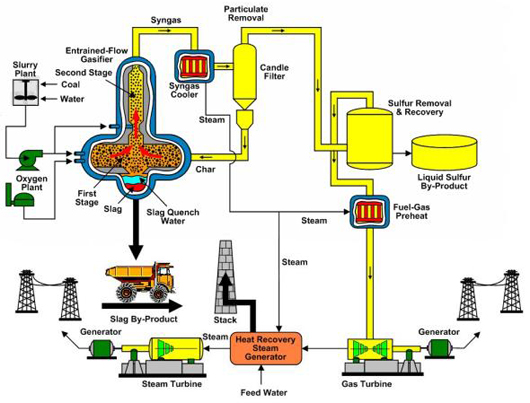
Wabash River Coal Gasification Repowering Project Process Flow Diagram (source)
Environmental Considerations
DOE analyzed environmental issues associated with the project according to National Environmental Policy Act (NEPA) standards. In addition, PSI, Destec, and two environmental consulting firms prepared a detailed environmental information volume providing inputs to an Environmental Assessment for the project. A positive NEPA assessment led to DOE issuing a Finding of No Significant Impact in May of 1993. All Federal, state, and local permits and approvals were obtained in combination with the establishment of a process and environmental monitoring program.
Plant design was conducted with the goal of outperforming the Clean Air Act (CAA) emission standards, which limit sulfur dioxide (SO2) at 1.2 lb/million Btu of fuel input and NOX at 0.15 lb/million Btu. Demonstrated emissions are much under these targets (see linked report below).
Despite power generation at the Wabash River complex being almost three times that of the original unit, the total emissions are a fraction of the pre-powering values as a result of the IGCC system.
Cost/Schedule
Total cost of the project was $438 million, which included construction and operation during the four-year demonstration period. DOE provided $219 million (50%) of the total cost.
A cooperative agreement was reached between Wabash River and DOE in July of 1992 with construction beginning in July of 1993. Operation commenced in November of 1995 and the completion of demonstration activities and turnover to commercial operations began in January of 2000. Unusually severe weather hampered activities in the first year of the construction phase of the project. Seven-day construction schedules were employed with peak construction activity reaching over 1,000 workers on site daily.
Operational History
Over the course of the demonstration, the Wabash River Project processed 1.5 million tons of coal, generating more than 4 million MWh of electricity. Thermal efficiencies of the plant were 39.7% for coal and 40.2% for petroleum coke (higher heating value basis). Plant availability averaged 70% in 1998-99, reaching as high as 77% in any given nine-month average. The plant demonstrated stable operation and was successfully operated on baseload dispatch in the PSI system.
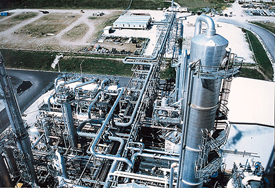
Wabash River IGCC Gas Cleanup System (source)
Initial operations found several problems that have been addressed successfully. Improvements in rod mill operation and installation of a new burner resulted in increased carbon conversion, reducing carbon in the slag from about 10% to around 5 %.
Ash deposition at the inlet to the firetube boiler was corrected by modifying the hot gas path flow geometry and velocity. Breakthrough of particles in the barrier filter system was corrected by replacing the ceramic elements with metallic candles. Early replacement of the COS hydrolysis catalysts, due to poisoning by chlorides and metals, was remedied by the installation of a wet chloride scrubber system and a change of catalyst.
A new mechanical method for cleaning boiler tubes was developed to reduce corrosion and decrease filter blinding. Acid gas removal was improved by expanding the system capacity for removing heat-stable salts from the circulating amine solution.
The expansion bellows between the syngas module and the turbine required redesign to eliminate cracking flow sleeves. Solenoid valves in the syngas purge lines were also redesigned and replaced. Replacement of the fuel nozzles was selected as a solution to cracking combustor liners.
electrical generating technologies
The Integrated Gasification Combined Cycle (IGCC) application of gasification offers some water-saving advantages over other technologies for producing electricity from coal. Regions with limited water resources, typical of many parts of the western United States, could conserve resources by meeting increasing electricity demand with IGCC generation. Many of these areas have good coal resources and a need for new generating capacity.
Water use in a thermoelectric power plant is described by two separate terms: water withdrawal and water consumption. Water withdrawal is the amount of water taken into the plant from an outside source. Water consumption refers to the portion of the withdrawn water that is not returned directly to the outside source – for example, water lost to evaporative cooling.
The thermoelectric industry is already a huge water user on the national level and must compete with several other applications for water supply. The total quantity of water withdrawn for thermoelectric power in 2005 was estimated by the United States Geological Survey to be 201 billion gallons per day, which was 49% of total water withdrawal, 41% of total freshwater withdrawals for all categories, and 53% of fresh surface-water withdrawals.
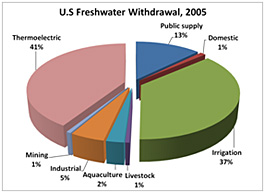
U.S. Freshwater Withdrawal 2005
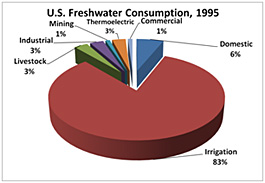
U.S. Freshwater Consumption, 1995
With increasing energy demand, water consumption resulting from energy industry activities will only continue to grow. The Energy Information Administration (EIA) projects that total electric consumption will increase from 4,152 billion kilowatt-hours in 2010 to 5,004 billion kilowatt-hours in 2035. Coal fired power generation is expected to increase by 11 GW from 2010 to 2035 (see gasification markets).2 The result will be more pressure on the nation’s water resources.
Water Use in Thermoelectric Power Plants
The main demand for water within a thermoelectric power plant is for condensing steam. Thermoelectric power generation typically converts the energy in a fuel source (fossil, nuclear, or biomass) to steam and then uses the steam to drive a turbine-generator. After the steam is exhausted from the turbine it is condensed and recycled for use in the production of steam again. Since the condensate must be cooled as much as possible to reduce backpressure on the turbine, this recycling of the steam is a critical process in the efficiency of the plant.
Generally three types of cooling system designs are used for this application: once-through, wet recirculating, and dry.
Once-through systems draw cooling water from a lake, river, or ocean to condense the steam exhausted from the turbine and then discharge the water back to the same body of water. This type of plant then has a relatively high water withdrawal, but not much of the water is actually consumed.
The wet recirculating cooling systems consist of two main technologies: wet cooling towers, and cooling ponds. The more common type, the cooling tower, dissipates heat by circulating the heated water through the tower where some of the water evaporates as most of it is cooled. In the cooling pond system natural conduction and convection transfer heat from the water discharged into the pond to the atmosphere. In both cases water withdrawal is relatively low, but due to the evaporation of water to the atmosphere and the need to remove blowdown from the system, water consumption is relatively high.
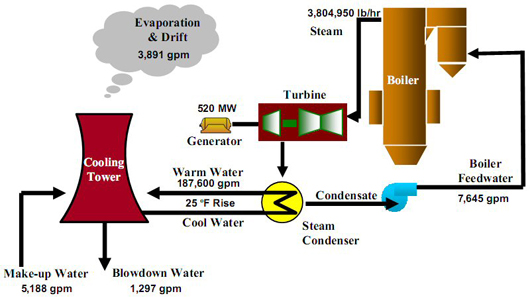
Schematic of a wet recirculating cooling water system for a 520-MW Coal-Fired Boiler
In dry cooling systems the steam exhausted from the turbine is cooled by forcing ambient air across a heat exchanger filled with the condensing steam. There is no loss of water to evaporation or blowdown in this configuration and therefore both water withdrawal and consumption are minimal; however use of this type of system is limited. Since air is not nearly as efficient for heat transfer as is water, the increased electrical cost makes dry cooling less economical.
Within the United States, each of these types of systems are used with 2010 estimates indicating that 42.7% of power plants use once-through, 41.9% use wet recirculating, 14.5% cooling ponds, and 0.9% dry cooling systems.3
Pulverized Coal vs. IGCC
In a pulverized coal (PC) combustion power plant, the coal is burned to produce steam via a pulverized coil boiler. The steam is then used to create electricity with a steam turbine connected to a generator. The steam exhausted from the turbine is then cooled in the condenser with cooling water usually supplied by a cooling tower which loses water through evaporation and blowdown. Most of the water consumption within the plant is for this purpose.
In addition, water is used in the PC plant configurations for emission control. Flue gas desulfurization (FGD) systems use water combined with limestone or other agents to create a slurry which is used in the treatment of the flue gas to remove sulfur and lower SO2 emissions to the required levels. Also, plant operators commonly add or leave 20–30% water in solid wastes generated, the bulk of which is fly ash, for dust control and optimum bulk density of those materials. If this water is part of the plant water effluents it may contain dissolved salts and minerals. Some plants practicing zero water discharge may add a small amount of solid salts and minerals (from water effluent evaporation) to these solid residues.
In an IGCC setting, water consumption is dramatically reduced compared with PC plants due to the reduced reliance on steam on a consistent electrical output basis. Since the syngas produced by the gasification process is combusted in a gas turbine, steam is not used as the primary means of transferring the energy from the coal to rotational energy. Steam is only used to recover the heat from the gas turbine exhaust in a heat recovery steam generator (HRSG). This reduces the steam system size required on an IGCC plant significantly, compared to a PC plant of similar electrical output.
This reduction can be offset by the fact that an IGCC plant uses water in process areas, including providing steam to the gasifier, in acid gas removal, carbonyl sulfate hydrolysis, particulate and mercury removal, humidification of syngas prior to the gas turbine, and in the water-gas shift reaction. Some gasifiers also use water for ash and slag handling processes.
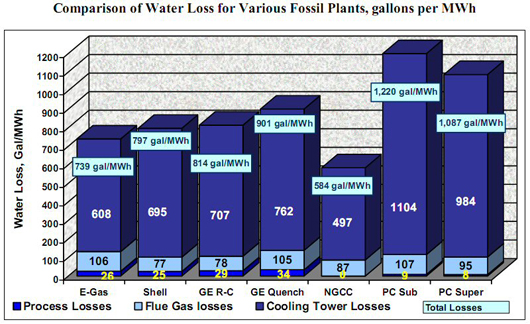
The following chart, taken from the August 2005 Power Plant Water Usage and Loss Study published by NETL, shows the varying levels of water loss or consumption for several IGCC technology options (E-Gas™, Shell, and GE Energy), NGCC, and subcritical and supercritical PC, on a consistent megawatt-hour basis.
This chart, taken from the August 2005 Power Plant Water Usage and Loss Study published by NETL, shows the varying levels of water loss or consumption for several IGCC technology options (E-Gas™, Shell, and GE Energy), NGCC, and subcritical and supercritical PC, on a consistent megawatt-hour basis.
Water Use in a Carbon Capture Scenario
If future limitations on carbon emissions require generating plants with the ability to separate and capture carbon emissions, increased water usage will be required for all electrical generating technologies. However, since the IGCC process adapts more easily to CO2 removal, the increase in water use for carbon capture is marginal compared to plants of other types. In fact, in a carbon capture scenario, IGCC plants are nearly as conservative in water consumption as natural gas combined cycle (NGCC) plants. The chart below shows estimated water usage figures for the power plant technologies in both carbon capture and non-capture scenarios.
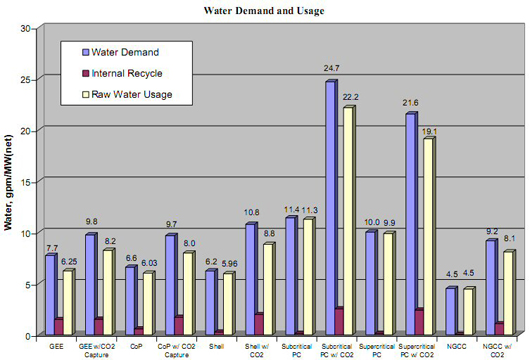
Estimated water usage figures for the power plant technologies in both carbon capture and non-capture scenarios
What can IGCC’s reduced water requirements mean to the nation’s energy and water resources in the future? Combining EIA demand projections and the information in the charts above, IGCC has the potential to save as much as 640,000 gallons per minute or 300 billion gallons per year of raw water by 2030. In the case of carbon capture requirements, 1.9 million gallons per minute or one trillion gallons per year of raw water could be saved.
So, in summary it can be said that gasification-based power offers efficiency benefits in the use of water. Raw water use in IGCC plants is lower than in pulverized coal plants. Without CCS, PC plants have a much higher steam turbine output, requiring more cooling water and condenser duties (typical raw water use ratio of 1.7:1.0). With carbon capture, the difference in water use is even more dramatic (2.5:1.0), as the chemical absorption process for CO2 capture in PC plants (amine) requires even more cooling water. In terms of raw water increase, CO2 capture increases raw water use by 37% for IGCC plants, versus a 95% increase for PC plants.
rare earths from coal mine wastes
Avalon Advanced Materials Inc. (TSX: AVL) (OTCQB: AVLNF) is pleased to announce that it has signed a binding Letter of Intent ("LOI") with a private US company, Coal Strategy Advisors, LLC, ("CSA") to earn up to a 50% interest in the Will Scarlett Rare Earths Recovery Project ("Will Scarlett") located near Marion, Illinois. Will Scarlett is a closed coal mine site where recent geochemical sampling has found elevated levels of rare earth elements (or "REE") and other metallic elements such as cobalt, nickel, lithium, manganese and zinc in mine waste materials.
The rare earths are found at Will Scarlett in the acid mine drainage ("AMD") and in the precipitates generated from lime treatment of the AMD to neutralize the acidity. Sampling of the precipitates and AMD has revealed high concentrations of total rare earth oxides in excess of 500 ppm. Also notable is that, unlike most hardrock rare earth resources, no significant uranium or thorium has been detected associated with the rare earths at Will Scarlett.
The potential for economic recovery of rare earths from coal mine wastes and fly ash has been receiving a lot of study in the United States. This has accelerated recently with the introduction of new US government initiatives to reduce reliance on China as a source of these critical minerals. These unusual occurrences represent an interesting opportunity to create a new primary rare earths supply relatively quickly and at a low cost compared to typical hardrock resources. CSA has made application for funding being made available by the US government for new rare earth supply chain projects.
Avalon and CSA plan to proceed immediately with analytical and process testwork to confirm concentration levels and the most efficient extraction process to recover the rare earths from the AMD and precipitates. Once this is confirmed, a detailed budget for construction of a demonstration plant can be established which will then determine what the Company's share of costs will be to earn its interest in Will Scarlett. Initial analytical testwork is already in progress. Avalon and CSA will enter a formal joint venture agreement once the full scope of work required to advance the project to initial production is determined. Avalon will also be providing its technical expertise to help manage the exploration and development work at the site in collaboration with CSA.
Commented Avalon President and CEO, Don Bubar, "In our research to date on rare earths in coal mine wastes, Will Scarlett stands out as exceptional in terms of the levels of rare earths present in the AMD. Like our East Kemptville Tin Project in Nova Scotia, Will Scarlett provides Avalon with an opportunity to extract value out of previously-mined waste materials at a relatively low cost, and potentially fully remediate the long term environmental liability associated with acid mine drainage at the site."
About Avalon Advanced Materials Inc.
Avalon Advanced Materials Inc. is a Canadian mineral development company specializing in niche market metals and minerals with growing demand in new technology. The Company has three advanced stage projects, all 100%-owned, providing investors with exposure to lithium, tin and indium, as well as rare earth elements, tantalum, niobium, and zirconium. Avalon is currently focusing on developing its Separation Rapids Lithium Project, Kenora, ON and its East Kemptville Tin-Indium Project, Yarmouth, NS to production, while continuing to advance its Nechalacho Rare Earths asset. Social responsibility and environmental stewardship are corporate cornerstones.
Approvals for new coal mine construction in China have surged in 2019, government documents showed, with Beijing expecting consumption of the commodity to rise in the coming years even as it steps up its fight against smog and greenhouse gas emissions.
Long-term cuts in coal consumption are a key part of China’s energy, environment and climate goals, but the fivefold increase in new mine approvals in the first-half of 2019 suggests China’s targets still provide ample room for shorter-term growth. China’s energy regulator gave the go-ahead to build 141 million tons of new annual coal production capacity from January to June, compared to 25 million tons over the whole of last year, Reuters analysis of approval documents showed.
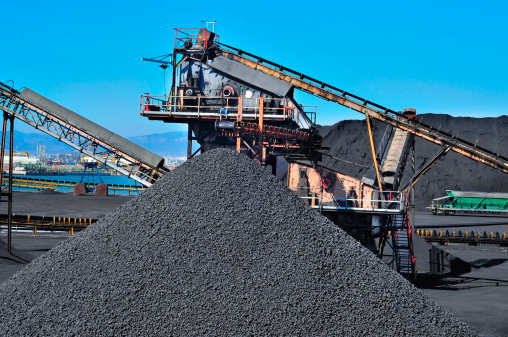
The projects included new mines in the regions of Inner Mongolia, Xinjiang, Shanxi and Shaanxi that are part of a national strategy to consolidate output at dedicated coal production “bases,” as well as expansions of existing collieries, the National Energy Administration (NEA) documents showed.
The NEA did not immediately respond to a request for comment. Beijing aims to raise the share of non-fossil fuels in its overall energy mix to 15% by the end of next year from around 14.3% currently, and to 20% by 2030. It cut the share of coal to 59% last year, down from 68.5% in 2012.
It has also promised to adopt the “highest possible ambition” when it reviews its climate change pledges next year, with one government think tank recommending China imposes a mandatory cap on coal consumption in its 2021-2025 five-year plan. But while smog-prone regions like Hebei and Beijing have already cut coal use and shut hundreds of small mines and power plants, China is still allowing for significant increases in coal production and coal-fired power generation.
That has piled pressure on utilities to use clean combustion technology. Lauri Myllyvirta, senior energy analyst with environmental group Greenpeace, said many of the newly approved projects would likely replace small or depleted old mines.
“However, it is alarming that China’s energy planning seems to be driving at roughly maintaining current levels of coal output for the coming decade or two, which is very hard to reconcile with the goal of the Paris agreement (on climate change),” he said. “Especially given that oil and gas consumption is still increasing, it’s imperative that coal use starts falling again after rebounding for the past three years.”
Chinese coal output rose 2.6% in the first-half of 2019 to 1.76 billion tons.
MORE TO COME?
Industry groups still expect coal-fired power capacity to increase over the next few years, with investments in nuclear and renewables still insufficient to cover rising energy demand. The research unit of the China State Grid Corporation last month forecast that total coal-fired capacity would peak at 1,230-1,350 gigawatts (GW), which would mean an increase of about 200-300 GW.
A study published earlier this year also suggested China’s targets would allow the construction of another 290 GW of coal-fired capacity in the coming years. China is convinced it can continue to raise coal production and consumption while significantly reducing emissions. It has made “ultra-low emissions” technology mandatory in all new coal power plants an is also improving mine zoning regulations to ensure pollution is minimized.
By the end of last year, 80% of total coal-fired power capacity had installed “ultra-low emissions” equipment, amounting to 810 GW, the government said. Michelle Manook, chief executive of the World Coal Association, an industry lobby group, told Reuters that coal remains a crucial element in the world’s transition to cleaner energy, and the focus should be on cutting emissions rather than banning coal entirely.
“It’s not about transitioning away from any one source of energy. it’s about transitioning to cleaner energy. And with investment, coal has a significant role,” she said.
Subscribe to:
Posts (Atom)